

The Software Development Discovery Phase: What to Decide Before a Build Starts
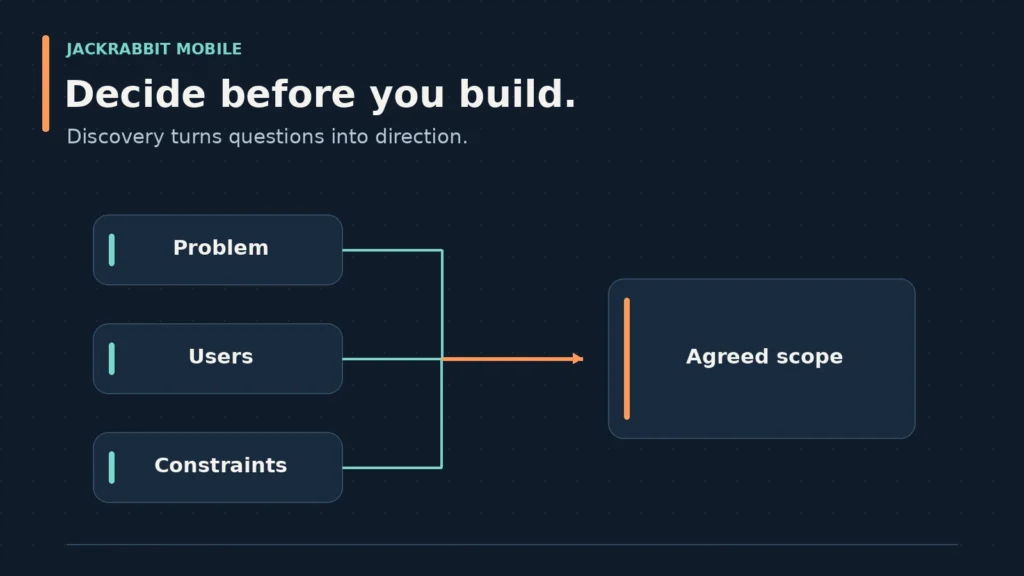
A software development discovery phase is the structured work you do before writing code: you define the problem, the users, the scope, and the risks. It answers one question: what are we actually building, and why? Teams that skip it often ship the wrong thing faster; teams that run it well make scoped decisions with fewer expensive surprises.
At Jackrabbit Mobile, we see discovery as the foundation for a build that has a clear direction. This guide explains what the phase is for, what it should produce, and how to use it to make a scoped project decision.
What a Discovery Phase Is For
The software development discovery phase exists to turn an idea into a decision-ready project. You’re not building the product yet. You’re building the shared understanding that makes the build possible.
A useful discovery process produces a few things: a clear problem statement, a defined user, a scope boundary, a technical direction, and a list of risks you’ve chosen to accept or address. That output matters because it changes how you estimate, staff, and sequence the work.
The phase also forces alignment. Stakeholders often agree in meetings and disagree in requirements. Discovery makes those disagreements visible early, when they’re cheap to fix. A product owner who wants offline access and an executive who wants a fast web launch can’t both be right without a trade-off conversation. Discovery is where that conversation happens.
You should also treat discovery as a filter. If the process shows the project is too expensive, too risky, or too vague to proceed, that’s a successful outcome. You’ve spent a fraction of the build cost to learn something a full development effort would have taught you much later.
Define Goals, Users, and the Real Workflow Problem
Most software projects start with a solution in mind: “We need an app for that.” The discovery phase starts one step earlier. What is the actual problem, and who has it?
Start with the business goal
A goal like “increase repeat orders” is more useful than “build a customer portal.” The goal gives you a way to evaluate features. If a proposed feature doesn’t move the goal, it’s scope you can cut. Write the goal in one sentence. If you can’t, the project isn’t ready for development.
Name the user
“Everyone” is not a user. A field technician who needs offline access on a tablet is a user. A manager who needs a weekly summary is a different user. Discovery should identify the primary user, their context, and the task they’re trying to complete. That specificity drives design, permissions, and platform choices.
Map the current workflow
Ask what happens today without the software. Who does what, in what order, with what tools? Where does the process break? The software should fix a real workflow problem, not recreate a paper process on a screen. If you can’t describe the current state, you’ll struggle to design the future state.
This part of the process often reveals that the original idea solves a symptom, not the cause. For example, a request for a reporting dashboard may point to a deeper issue: data that lives in disconnected systems and needs to be brought together before reporting can be useful. Discovery gives you the chance to address the underlying integration problem directly.
Set Scope, Requirements, and Decision Ownership
Scope is where discovery earns its keep. A scoped project has boundaries: what’s in, what’s out, and what’s undecided.
Requirements that describe behavior
Write requirements as behaviors, not features. “A user can submit an order without re-entering their address” is testable. “User-friendly checkout” is not. The discovery phase should produce requirements specific enough that a developer can estimate them and a tester can verify them.
Prioritize ruthlessly. A common discovery deliverable is a prioritized backlog: must-have, should-have, and later. The must-have list is your minimum viable product. Everything else is a candidate for a future phase.
Decision ownership
Every requirement needs an owner. Who decides when there’s a conflict between speed and design? Who approves a scope change? If the answer is “the committee,” decisions will stall. Discovery should name the person or small group with final say on product decisions.
That ownership also applies to the vendor side. If you’re working with a development partner, clarify who writes the requirements, who reviews the designs, and who signs off at each stage. Ambiguity here causes rework later.
Explore Architecture, Risks, and Project Assumptions
The software development discovery phase isn’t just a business exercise. It should also test the technical direction before you commit to it.
Architecture direction
You don’t need a complete system design, but you do need enough architecture to make informed choices. Will this be a native mobile app, a cross-platform app, or a web application? What data does it need, and where does that data live? Are there existing systems to integrate with?
Those choices have consequences. A native app gives you better hardware access and performance but costs more to build and maintain across platforms. A web app is faster to ship but may not meet offline or device-specific needs. Discovery is the time to weigh those trade-offs against the user and workflow you defined earlier.
Risk identification
List the risks that could sink the project. Common ones include unclear requirements, third-party API dependencies, legacy system integration, security or compliance needs, and performance expectations. For each risk, decide whether to investigate further, mitigate it in the design, or accept it.
A risk register doesn’t need to be formal. A simple table with the risk, its likely impact, and the planned response is enough. The point is to make risks visible before they become emergencies.
Assumptions
Every project runs on assumptions. The payment provider will support recurring billing. The legacy database will handle the new load. The client team will be available for weekly reviews. Write those assumptions down. Then ask which ones would break the project if they turned out to be false. Test those first.
What a Useful Discovery Output Should Give the Team
The deliverables from a software development discovery phase should be practical enough to guide the next decision: whether to proceed, and with what scope.
A strong discovery package includes:
- A one-page problem statement and business goal
- A description of the primary user and their core workflow
- A prioritized list of behavioral requirements
- A scope boundary: what’s in the first release, what’s explicitly out
- A technical direction with platform and integration choices
- A risk list with mitigation or acceptance decisions
- A rough estimate and delivery approach for the first build phase
That package gives stakeholders what they need to say yes, no, or “yes, but smaller.” It also gives the development team a foundation for planning, design, and estimation.
The output should not be a 200-page document nobody reads. Useful discovery deliverables are short, specific, and decision-oriented. If a section doesn’t help someone make a choice, cut it.
How Long Does a Discovery Phase Last?
The length depends on project complexity, not on a universal rule. A small internal tool with one user type and no integrations might need a week. A regulated product with multiple user roles, legacy systems, and security requirements could take four to six weeks or more.
What matters is that the phase has a defined end. Discovery can expand indefinitely if you let it. Set a timebox, list the questions that must be answered, and stop when they’re answered. You can schedule a follow-up investigation for a specific risk without reopening the entire phase.
Frequently Asked Questions
What are the 7 stages of software development?
The seven stages commonly described are planning, requirements analysis, design, development, testing, deployment, and maintenance. The software development discovery phase fits primarily within planning and requirements analysis, though it also informs design and architecture choices. Different teams name these stages differently, but the sequence is consistent: understand before you build, verify before you release, and support after you ship.
What are the four phases of discovery?
A common four-part structure is: define the problem and goals, research the users and current workflow, explore solutions and technical options, and validate scope and risks. Some teams split these differently, but the core sequence is the same: understand the problem, learn who has it, evaluate possible approaches, and confirm what’s worth building.
What are the 5 phases of SDLC?
The five-phase SDLC model typically includes planning, design, development, testing, and deployment. Some models add maintenance as a sixth phase or split requirements out of planning. The software development discovery phase belongs in the planning stage, where it shapes the requirements, scope, and technical direction that the later phases depend on.
How long does a discovery phase last?
Most discovery phases run between one and six weeks. A simple project with clear requirements and no integrations can finish in a week. A complex project with multiple user types, legacy systems, or compliance needs may take longer. The key is to timebox the phase and stop when the critical questions are answered, not when every possible question has been explored.
Talk Through Your Project with Jackrabbit Mobile
If you’re weighing a custom software, mobile app, web application, integration/API, cloud, UI/UX, QA/testing, or maintenance project, we’re happy to discuss your goals, requirements, and the decisions in front of you. Contact Jackrabbit Mobile to start that conversation.
 Older posts